

Dear Friend,
Boy oh boy, the world is spinning faster than ever… This last week has been yet another week of AI insanity. Meanwhile, we are sweating at an unprecedented 86 degrees Fahrenheit here in Boulder, CO (we usually see snow around this time of year), and I am writing this in the rain and 45 degrees Fahrenheit while being out for a weekend of ice climbing in the Canadian Rockies in Canmore, Alberta… We will see how the ice is tomorrow – just arrived.
And now, this…
Headlines from the Future
Even the Consultants Can’t Make AI Work for Them. Here is an interesting one: McKinsey created and deployed their own AI assistant “Lilly” - and in their write-up about it, they report that 72% of their employees are using it by tossing 500,000 prompts at it per month.
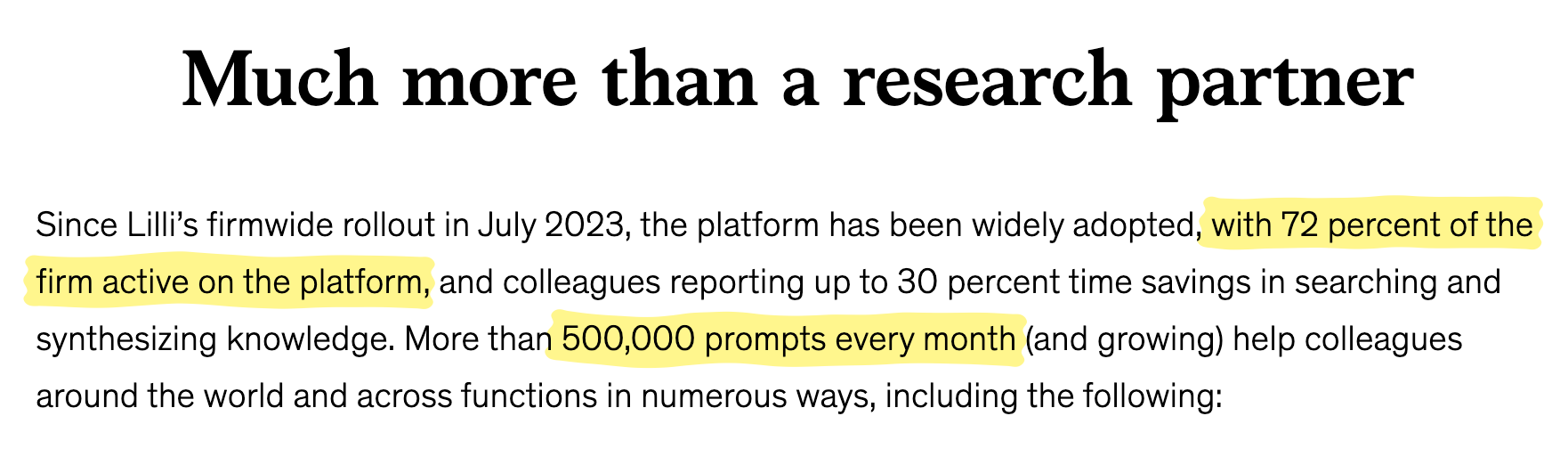
72% of McKinsey’s employees are about 29,000 people. 29,000 people prompting their AI 500,000 times a month is only 17 prompts per person per month! That’s about one prompt every other day… Not exactly a lot. I prompt Claude easily 17 times in a single day…
━━━━━
McKinsey Can’t – But Individuals Do. In stark contrast to McKinsey, solo-developer Craig Mod built his own (fairly complex) accounting system from scratch using Claude Code in five short days. Aside from the audacity of it all, it’s a perfect example of the “bifurcation of intelligence” we have been talking about here in the radical Briefing. On one hand you have big firms seeking efficiency gains by deploying chatbots, and on the other you have individuals riding the speartip of AI to create complex, bespoke systems.
Simply put: It’s a big mess, and no off-the-shelf accounting software does what I need. So after years of pain, I finally sat down last week and started to build my own. It took me about five days. I am now using the best piece of accounting software I’ve ever used. It’s blazing fast. Entirely local. Handles multiple currencies and pulls daily (historical) conversion rates. It’s able to ingest any CSV I throw at it and represent it in my dashboard as needed. It knows US and Japan tax requirements, and formats my expenses and medical bills appropriately for my accountants. I feed it past returns to learn from. I dump 1099s and K1s and PDFs from hospitals into it, and it categorizes and organizes and packages them all as needed. It reconciles international wire transfers, taking into account small variations in FX rates and time for the transfers to complete. It learns as I categorize expenses and categorizes automatically going forward. It’s easy to do spot checks on data. If I find an anomaly, I can talk directly to Claude and have us brainstorm a batched solution, often saving me from having to manually modify hundreds of entries. And often resulting in a new, small, feature tweak. The software feels organic and pliable in a form perfectly shaped to my hand, able to conform to any hunk of data I throw at it. It feels like bushwhacking with a lightsaber.
━━━━━
Stop Sloppypasta. Like it or not, you will have to deal with AI-generated content – both personally and professionally. Colleagues who are responding to a request with an AI-generated response, emails being written by your favorite LLM, proposals being created with the help of your friendly chatbot. The question might truly not be “if” but “how” – here is a set of very reasonable guidelines and practices to help you navigate this brave new world.
AI capabilities keep increasing, and using it to draft, brainstorm or accelerate you will be increasingly useful. However, using AI should not make your productivity someone else’s burden. New tools require new manners. Use AI to accelerate your work or improve what you send. Don’t use it to replace thinking about what you’re sending.
━━━━━
OpenClaw Isn’t Really New – It’s The Dream of Free Labour. Unless you were living under a rock in AI-land, you’ve definitely heard of the OpenClaw craziness (we reported on it multiple times here in the radical Briefing). The narrative, usually, is around the technological breakthrough and the magic that ensues when you hand over the keys to the kingdom to your army of AI bots. Here’s a good counter-narrative – the tech isn’t new per se, it’s just combined and connected in an interesting way. And the hype, really, is about the never-ending dream of free labour – and ends up being more about FOMO than anything else.
A machine producing a thousand candidate images while you sleep is plausible and often useful. A machine founding a hundred profitable businesses before breakfast is rather more ambitious. The first is a search process. The second is venture-capital fan fiction.
What We Are Reading
Dario Amodei’s Oppenheimer Moment Dario Amodei may be having his Oppenheimer moment, and judging by the Pentagon’s latest move, he never really had a choice. @Jane
After-Hours Meetings Are on the Rise; AI Could Make Things Even Worse Everyone is in agreement that there shouldn’t be so many meetings, but unfortunately they’re on the rise. Specifically, after-hours meetings due to more global teams and distributed workforces. @Mafe
Why Tech Bros Are Now Obsessed With Taste As the zeitgeist turns and startup entrepreneurs scramble to differentiate their offerings in an era of AI abundance, prepare to hear way, way too much about “taste” and “discernment” – and tune your BS detector accordingly. @Jeffrey
Why an Unsustainable Bubble Is Growing in Fintech When growth is manufactured through pricing arbitrage and balance sheet gymnastics, you’re not building a market; you’re distorting one. @Kacee
Why ATMs Didn’t Kill Bank Teller Jobs, but the iPhone Did You know the story about ATMs and bank tellers – this deep dive into what actually happened (and keeps happening) is a good reminder to be skeptical of the lore at large. @Pascal
Down the Rabbit Hole
🔮 Silicon Valley legend Kevin Kelly on “How to Future.”
🧑🏼🎓 A professor’s honest assessment on “why I may ‘hire’ AI instead of a graduate student.”
🧑🏼🏫 Headline captures it all: “If AI is writing the work and AI is reading the work, do we even need to be there at all?” Educators reveal a growing crisis on campus and off.
🧑🏼 Not that anyone ought to be surprised: CEO asks ChatGPT how to void $250 million contract, ignores his lawyers, loses terribly in court.
🧸 AI is making its way into children’s toys. Parents ought to be cautious: AI toys for children misread emotions and respond inappropriately, researchers warn.
👨🏼💻 AI-generated code is awesome – and can be pretty bad: Top AI coding tools make mistakes one in four times, study shows.
🦞 OpenClaw is everywhere – and nowhere as much as in China: How China is getting everyone on OpenClaw, from gearheads to grandmas
😱 Don’t bring a knife to a gunfight. Someone built a $97 missile – with a $5 sensor for flight control. All open source, 3D print, and build-your-own. Talk about asymmetric warfare.
👮🏼 False positives keep being a real problem – with very real consequences: US woman wrongly imprisoned for 6 months due to faulty facial recognition.
🥸 Opposite approach – similar issue: You can’t trust facial recognition (see above), and you can’t trust the face either: The face recommending your next health product is fake, the money leaving your wallet is not.
🎧 Here is a delightful music web app that lets you listen to what a particular country was enjoying in a specific year.
🙊 Independent search engine Kagi just released their genius LinkedIn Speak translator. Take any sensible (or not) English sentence and get back the gibberish that is LinkedIn Speak.
🌐 Headline says it all (also: Schadenfreude is real for some): RIP Metaverse, an $80 billion dumpster fire nobody wanted
👁️ The longest line of sight in the world – took eight years to figure out.
↗ Dive into the deep end: Access our complete collection of 2,600+ radical links.
Should We Work Together?
Hi! I’m Pascal from radical. This newsletter is our labor of love. When we’re not writing, we run radical, a firm that helps organizations navigate the future without the “innovation theater.” Most leaders want to seize new opportunities, but they hate endless strategy decks that go nowhere. At radical, we don’t run “projects”; we build your organization’s internal capacity to handle disruption and change. Our goal is to make you future-proof so you can stop reacting to the world and start shaping it. If you’re interested, let’s jump on a call to see if we’re a good fit. Click here to speak with us.