

Dear Friend,
Remember the glorious days when Uber and Lyft were heavily subsidized by their venture capital sugar daddies and you couldn’t get over how cheap it is to get a ride? Yeah, those days are gone (and much can be said about the market-distorting effects of the VC-fueled subsidies). Well, it increasingly looks like the sweet days of $20/month all-you-can-prompt AI plans are also coming to an end – pretty much all the major AI companies are tweaking their pricing strategies, making tokens for their latest frontier models much more expensive, and generally trying to dig themselves out of the “for every dollar we make, we lose five”-hole. It doesn’t come as a surprise – but it will be interesting to see what it does to market demand.
And now, this…
Headlines from the Future
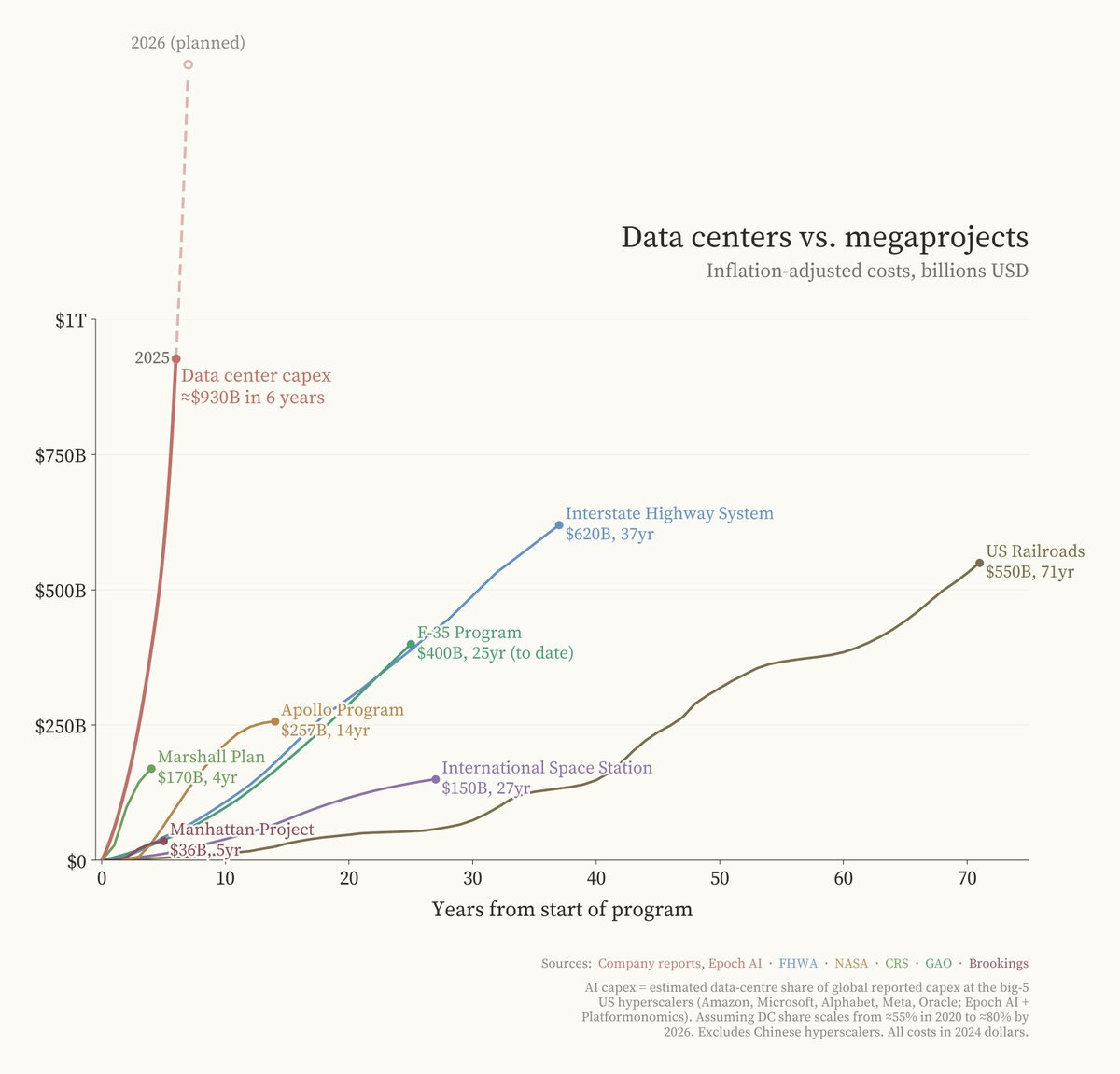
Putting the AI Investment into Perspective. As the saying goes – a picture is worth a thousand words.
━━━━━
Are the Costs of AI Agents Also Rising Exponentially? With AI models becoming more and more powerful, the cost of inference (at least for frontier models) is staying about the same (or increases) and the models consuming vastly more tokens for a given task. This being said, Toby Ord did a fascinating analysis of the cost of running AI agents as a function of “cost of labour” – and found that agents sometimes cost much more than human labour (“How is the ‘hourly’ cost of AI agents changing over time?”). In sum:
This provides moderate evidence that:
the costs to achieve the time horizons are growing exponentially,
even the hourly costs are rising exponentially,
the hourly costs for some models are now close to human costs.
━━━━━
Cyber Security Is a Completely Different Game Now. If you have even half an ear to the ground when it comes to cybersecurity, you have heard stories about Anthropic’s newest model “Mythos” being held back as it is “too dangerous” – with the main fear being that it finds vulnerabilities in software with an unprecedented speed and accuracy. In fact, people are hacking all kinds of hard- and software using current state-of-the-art models such as GPT-5.4 or Opus for the last couple of months now. All of which turns cybersecurity into even more of a race between who can outspend whom, than it already is. In simple (AI economic) terms:
to harden a system we need to spend more tokens discovering exploits than attackers spend exploiting them [and] to harden a system you need to spend more tokens discovering exploits than attackers will spend exploiting them.
If you are running a system which has any public exposure surface (e.g. a website, an API, or an app), you better take this seriously. I wouldn’t be surprised if we will see tons of new exploits being executed in the next few months and years.
━━━━━
DIY Sequence Your Whole Genome. We have been talking about an individual’s ability to sequence their own genome at home, using lab-grade but DIY equipment, for a while now (it was one of the predictions floating around in the ether in the heyday of Singularity University – it was always “just around the corner”). Now it has (finally) happened – alas, not for the faint of heart.
So this week I sequenced my genome entirely at home. Literally on my kitchen table.
What We Are Reading
A New Kind of Hybrid Car Is About to Hit America’s Streets EREVs are the exciting new hybrid technology everyone should know about. Your car runs on electric power but quietly refuels its own battery with gas, so you never have to worry about being stranded! @Jane
TikTok Makes Americans Want Chinese EVs They Can’t Have Chinese car brands are nearly absent from US roads due to tariffs and regulations, but are building American consumer desire through social media while playing a long-term strategy. @Mafe
What Will Be Scarce? An economist goes deep on a relatively optimistic scenario for the future of human labor, finding durable value in what he calls the “relational sector,” where the value of the service is likely to be increasingly linked to the human providing it. @Jeffrey
The End of One-Size-Fits-All Enterprise Software Pascal and I have been writing about this lately, we’re moving from standardized systems to outcome-driven architectures that can conform to the business. @Kacee
Our newsroom AI policy As companies (and in this case, newsrooms) around the world grapple with what it means to operate in an AI-enabled/driven world, it will become more and more important for organizations to establish (and publish) clear guidelines and disclosures on their use of AI – here is a good example from the Ars Technica newsroom. @Pascal
Down the Rabbit Hole
✊ “We believe in human beings.” Union leaders are escalating their anti-AI rhetoric, portraying the industry’s leaders as profit-hungry “oligarchs” eager to replace humans.
☀️ Shine (not drill), baby shine: IEA – Solar overtakes all energy sources in a major global first.
✍️ Hacking the system: A college instructor turns to typewriters to curb AI-written work and teach life lessons.
☕ A wonderful lesson in taking something that worked (ordering coffee through a carefully designed app) and making it worse by using AI: Ordering with the Starbucks ChatGPT app was a true coffee nightmare.
🧑⚖️ Let AI be the judge: Cooperative negotiation is a solvable problem (or so says this company).
🔐 Turns out – your cybersecurity does, in fact, withstand the (possibly coming) wave of quantum computer-powered attacks (despite the attention-grabbing headlines): Quantum computers are not a threat to 128-bit symmetric keys.
🎠 Ed Zitron, one of the most outspoken critics of AI, is back (and it’s worth reading – even if you don’t agree with him): Four Horsemen of the AIpocalypse.
↗ Dive into the deep end: Access our complete collection of 2,700+ radical links.
Should We Work Together?
Hi! I’m Pascal from radical. This newsletter is our labor of love. When we’re not writing, we run radical, a firm that helps organizations navigate the future without the “innovation theater.” Most leaders want to seize new opportunities, but they hate endless strategy decks that go nowhere. At radical, we don’t run “projects”; we build your organization’s internal capacity to handle disruption and change. Our goal is to make you future-proof so you can stop reacting to the world and start shaping it. If you’re interested, let’s jump on a call to see if we’re a good fit. Click here to speak with us.
Hey, I remember when SU wanted to fully sequence genomes as an employee benefit until there was some legal pushback.
The more telling response was when I asked my Harvard PhD genetics research friend who immediately asked, "Why on earth would you do that?!"
She was all for the handful of targeted health conditions with well-researched genetic lineages. She even underwent a prophylactic mastectomy because of a BRCA1 mutation she later discovered. But most of the human genome is effectively "slop" in our current scientific eyes, with all sorts of mutation flags and zero knowledge whether they are harmful or not. Let alone should you, or could you, do anything about them.
Full human genome sequencing is what the walking worried do when they have enough time, privilege, and money to invent new things to worry about. More data is not always better.
Item #2: BYDs are not uncommon on the streets of Portugal, even as Uber rides. As they do make Teslas seem like half the car for more than twice the price, chalk up another consumer win for American tariff policy.
Another excellent newsletter. Two thoughts, though.
I believe that post-subsidy Uber fares roughly doubled, which stung for sure but I suspect if that's all the price increase tokens face, people will feel far less price sensitive than we did for rides. It's still a good deal at 2X the price. If instead we end up at 50X the token use due to agentic capabilities we just can't say no to, then yeah that's different. The number of Uber rides we take has a natural cap, at least in orders of magnitude, that agentic AI may not have before saturation. (Though most peoples' imagination imposes limits.) I had to chuckle at Ord's opening sentence, "There is an extremely important question about the near-future of AI that almost no-one is asking" - hello, Claudism #1. I actually think a lot of us are thinking about this, right? And I suspect it will accelerate development of more capable edge models.
That solar news is great, too. Albeit solar passing other energy sources in YoY growth, not absolute use. Were it not a near-existential issue, I could be patient, but come on, right? And it's complicated by the above, goalposts moving due to energy demand growth forecasts. (Which seem low to me at 30% etc but we'll see.)
Best wishes to the Radical team. -Marshall