

You lie motionless inside the narrow, humming tube of an fMRI scanner. The machine clicks and whirs. The researchers are about to make you feel something you wouldn’t expect to be painful. Instead of showing you scary pictures or shocking your finger with a current, they’re going to make you feel rejected.
In a now-famous study, participants played a virtual ball-tossing game while inside the scanner. At first, the other players passed the ball to you. You felt included. Then, abruptly, they stopped. They passed it only to each other, ignoring you completely. You were excluded. You were failing socially.
The brain scans revealed something harsh: the dorsal anterior cingulate cortex – the same region that activates when you’re punched in the stomach – lit up as though you’d been physically struck. Your brain doesn’t differentiate between the emotional pain of rejection and the physical pain of being hurt. It processes both as the same thing. Evolution shaped you this way. Throughout most of human history, social rejection meant expulsion from the tribe, which meant death. Your brain built a rapid alarm system to prevent it.
Which brings us to the most dangerous entity in your boardroom: not the skeptical CFO or the micromanager, but the prehistoric saboteur living inside your own skull – the amygdala.
Imagine – you’re in a quarterly review. The CFO asks a pointed question about your project’s burn rate. Your mouth goes dry. Your mind, which was sharp five seconds ago, suddenly feels foggy and slow. You know the numbers – you rehearsed the numbers – but they’ve vanished. You mumble something defensive. The meeting moves on. Later, in the elevator, the answer floods back, obvious and clear.
What happened? A war between your ears. In one corner: the prefrontal cortex, the CEO of your brain – logic, creativity, long-term planning all happen here. In the other corner: the amygdala, buried deep in your temporal lobes. Ancient. Fast. Unsophisticated but devastatingly effective. It doesn’t write poetry or design software – it keeps you alive by scanning for threats. And here’s the tragedy: these two systems operate like a seesaw. When one goes up, the other comes down.
The CFO’s pointed question? To your amygdala, it was indistinguishable from a predator in the tall grass. So it initiated a hostile takeover – flooding your bloodstream with cortisol, diverting energy to your legs and fists, and literally cutting blood flow to your prefrontal cortex. The lights in the CEO’s office went dark. You weren’t stupid in that meeting. You were chemically lobotomized.
This is the biological saboteur. And it’s running your company’s innovation efforts into the ground.
I want to throw something every time I walk into an innovation lab and see a poster that says “Fail Fast, Fail Forward.” It’s a beautiful sentiment. It is also biologically impossible in most organizations. You can’t just decide to be comfortable with failure any more than you can decide not to pull your hand back from a hot stove. If the environment triggers the threat response, the lizard wins. Every time.
You can buy all the bean bag chairs and install all the ping-pong tables you want, but if your culture punishes mistakes – even subtly – the amygdala wins every time. Simply stated: In most organizations, every idea that challenges the status quo is initially perceived by someone as a mistake. If your culture punishes mistakes, it is also punishing the early signals of innovation.
Think about the standard Monday morning status meeting. A project manager has to report that an initiative didn’t work. They’re nervous. The room goes quiet. You, the leader, say “It’s okay, we learned something” – but even those words betray you. “It’s okay” is a verdict disguised as comfort. It concedes that something wrong happened and positions you as the authority granting forgiveness. And forgiveness implies the possibility of its absence next time. If your tone is tight, if you sigh, if there’s a micro-expression of disappointment, the room detects it. Every brain in the room just received a signal: Error = Fear and Pain.
The result? People stop offering creative solutions (prefrontal cortex) and start offering defensive explanations (lizard). They stop saying “I wonder why that happened?” and start saying “Well, marketing didn’t give us the right assets.” All learning stops, and self-preservation begins.
So what do you do? You can’t wait another million years for evolution to update the firmware. You have to hack the software you have today.
Here’s one starting point: change the words you use. Words like “failure,” “mistake,” and “error” are loaded – they are threat triggers. When you ask “Why did this fail?”, you are practically begging the amygdala to wake up. Instead, try framing every outcome as a “first attempt in learning.” When you frame an outcome as a “failure,” you’re issuing a verdict. When you frame it as a “first attempt,” you’re describing a process. It implies iteration. It implies you’re not done yet. The lizard stays asleep. The CEO stays online.
And here’s the Monday morning test: at the start of your next crisis meeting, try calling out the biology explicitly. “Everyone’s lizard brain is freaking out right now. That’s normal. Let’s take two minutes to breathe so we can get our prefrontal cortexes back online.” It sounds silly. It works.
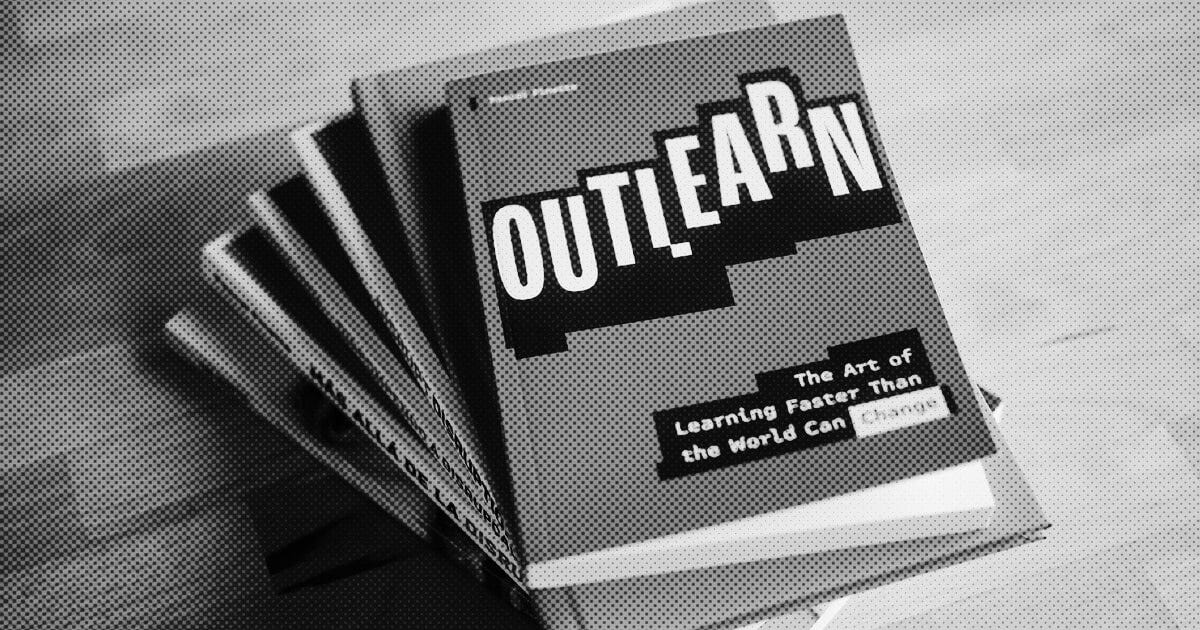
This is from Part II of my new book OUTLEARN: The Art of Learning Faster Than the World Can Change, which is live today on Amazon – paperback and ebook.
The book goes much deeper into the neuroscience, the linguistic hacks, and the math of why some failures lead to breakthroughs and others lead to bankruptcy. If this essay landed for you, grab a copy – and if you’re feeling generous, an honest Amazon review in the first week helps enormously.
@Pascal